
Optics: Lenses, Prisms, and Traversals in Practice
Part 2 of the Functional Optics for Modern Java series
In Part 1, we identified the immutability gap: modern Java excels at reading nested data through pattern matching, but it provides little help for writing. We introduced optics as the missing piece, providing composable abstractions that treat access paths as first-class values.
This time we go deeper into practical code with the three core optic types: lenses for product types, prisms for sum types, and traversals for collections. By the end, you’ll understand not just how to use each, but when and why.
Setting Up Higher-Kinded-J
Before we explore optics in depth, let’s configure our project to use Higher-Kinded-J’s annotation-driven generation.
To follow along, you will need Java 25, and if you are using Gradle, then 9.2.1 or newer.
Gradle Configuration
plugins {
    java
}

repositories {
    mavenCentral()
}
// This is the current version of HKJ
val hkjVersion = "0.3.4"

dependencies {
    // Core library with optics
    implementation("io.github.higher-kinded-j:hkj-core:$hkjVersion")

    // Annotation processors for lens/prism generation
    annotationProcessor("io.github.higher-kinded-j:hkj-processor-plugins:$hkjVersion")
}

java {
    toolchain {
        languageVersion.set(JavaLanguageVersion.of(25))
    }
}

tasks.withType<JavaCompile> {
    options.compilerArgs.addAll(listOf("--enable-preview"))
}

tasks.withType<JavaExec> {
    jvmArgs("--enable-preview")
}
Maven Configuration
<properties>
    <hkj.version>0.3.4</hkj.version>
    <maven.compiler.release>25</maven.compiler.release>
    <maven.compiler.enablePreview>true</maven.compiler.enablePreview>
</properties>

<dependencies>
    <dependency>
        <groupId>io.github.higher-kinded-j</groupId>
        <artifactId>hkj-core</artifactId>
        <version>${hkj.version}</version>
    </dependency>
</dependencies>

<build>
    <plugins>
        <!-- Required: enable preview features for application execution -->
        <plugin>
            <groupId>org.codehaus.mojo</groupId>
            <artifactId>exec-maven-plugin</artifactId>
            <configuration>
                <executable>java</executable>
                <arguments>
                    <argument>--enable-preview</argument>
                </arguments>
            </configuration>
        </plugin>
        <plugin>
            <groupId>org.apache.maven.plugins</groupId>
            <artifactId>maven-compiler-plugin</artifactId>
            <configuration>
                <annotationProcessorPaths>
                    <path>
                        <groupId>io.github.higher-kinded-j</groupId>
                        <artifactId>hkj-processor-plugins</artifactId>
                        <version>${hkj.version}</version>
                    </path>
                </annotationProcessorPaths>
            </configuration>
        </plugin>
    </plugins>
</build>
With the dependencies in place, we’re ready to get started.
Running the Examples
Article Code
All code examples from this article have runnable demos:
- LensDemo: Basic lens operations and composition
- PrismDemo: Prism operations and type-safe down casting
- TraversalDemo: List traversals and filtering
- CompositionDemo: Deep path composition for nested updates
- ExpressionPreviewDemo: Preview of the expression language we will develop in Part 3
The domain classes use Higher-Kinded-J’s annotation-driven generation, defined in org.higherkindedj.article2.domain.
Lenses: The Foundation
A lens focuses on exactly one value within a larger structure. It represents a “has-a” relationship: an Employee has an Address; an Address has a street. Lenses always succeed; the focused value is guaranteed to exist.
Generating Lenses
The @GenerateLenses annotation instructs Higher-Kinded-J to generate lens accessors for each record component:
import org.higherkindedj.optics.annotations.GenerateLenses;

@GenerateLenses
public record Address(String street, String city, String postcode) {}

@GenerateLenses
public record Employee(String id, String name, Address address) {}

@GenerateLenses
public record Department(String name, Employee manager, List<Employee> staff) {}
The annotation processor generates a companion class with lens factories:
// Generated: AddressLenses.java
public final class AddressLenses {
    public static Lens<Address, String> street() { ... }
    public static Lens<Address, String> city() { ... }
    public static Lens<Address, String> postcode() { ... }
}

// Generated: EmployeeLenses.java
public final class EmployeeLenses {
    public static Lens<Employee, String> id() { ... }
    public static Lens<Employee, String> name() { ... }
    public static Lens<Employee, Address> address() { ... }
}
Using Lenses
Each lens provides three core operations:
Lens<Address, String> streetLens = AddressLenses.street();

// Get: extract the focused value
String street = streetLens.get(address);

// Set: return a new structure with the focused value replaced
Address updated = streetLens.set("100 New Street", address);

// Modify: apply a function to the focused value
Address uppercased = streetLens.modify(String::toUpperCase, address);
The modify operation is particularly powerful: it combines get and set in a single traversal, ensuring the transformation is applied consistently.
Lens Composition
The real power emerges when you compose lenses. The andThen method chains lenses to reach further down into nested structures:
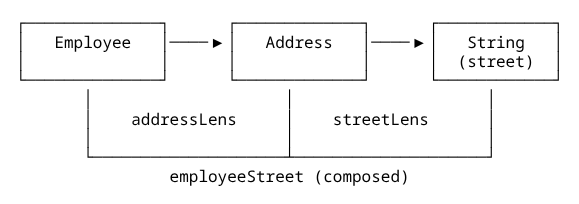
// Compose: Employee → Address → String
Lens<Employee, String> employeeStreet =
    EmployeeLenses.address().andThen(AddressLenses.street());

// Now we can get/set/modify the street directly on an Employee
String street = employeeStreet.get(employee);
Employee updated = employeeStreet.set("200 Oak Avenue", employee);
Employee transformed = employeeStreet.modify(s -> s + " (verified)", employee);
Each composed lens handles all the intermediate reconstruction automatically. That twenty-five-line copy-constructor cascade from Part 1? It’s now implicitly taken care of in the lens composition.
Lens Laws
Well-behaved lenses must satisfy three laws that ensure predictable behaviour:
-
Get-Set: If you get a value and then set it back, the structure is unchanged.
lens.set(lens.get(s), s) == s -
Set-Get: If you set a value, getting it returns what you set.
lens.get(lens.set(a, s)) == a -
Set-Set: Setting twice is the same as setting once with the final value.
lens.set(a2, lens.set(a1, s)) == lens.set(a2, s)
These laws aren’t just theoretical; they form the guarantee that lenses behave like mathematical getters and setters. The annotation processor generates lenses that will satisfy these laws automatically.
Pattern: Lens as Structural Path
Think of a lens as a “structural pointer” for your objects. Just as /employee/address/street navigates a JSON document, employeeAddress.andThen(addressStreet) navigates a Java object graph. The difference: it’s type-safe, and it works bidirectionally.
Prisms: Sum Type Access
Where lenses provide access to parts of a whole that are always present (product types). Prisms, conversely, attempt to access variants that might be absent (sum types). Think of a prism as a selective window: it only ‘sees’ the Shape if it happens to be a Circle.
The Optional Nature of Prisms
Consider a sealed interface:
public sealed interface Shape permits Circle, Rectangle, Triangle {}

@GenerateLenses
public record Circle(double radius) implements Shape {}

@GenerateLenses
public record Rectangle(double width, double height) implements Shape {}

@GenerateLenses
public record Triangle(double a, double b, double c) implements Shape {}
Given a Shape, we don’t know which variant it is. A prism for Circle must handle the possibility that the shape isn’t a circle at all.
Generating Prisms
The @GeneratePrisms annotation on a sealed interface generates prisms for each permitted subtype:
import org.higherkindedj.optics.annotations.GeneratePrisms;

@GeneratePrisms
public sealed interface Shape permits Circle, Rectangle, Triangle {}
This generates:
// Generated: ShapePrisms.java
public final class ShapePrisms {
    public static Prism<Shape, Circle> circle() { ... }
    public static Prism<Shape, Rectangle> rectangle() { ... }
    public static Prism<Shape, Triangle> triangle() { ... }
}
Using Prisms
Prisms provide different operations than lenses, reflecting their optional nature:
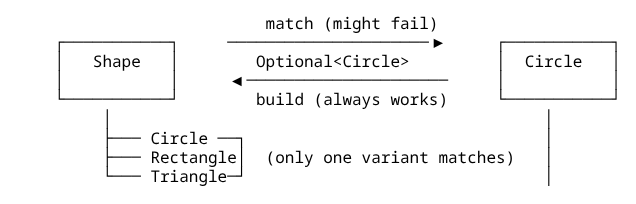
Prism<Shape, Circle> circlePrism = ShapePrisms.circle();

// getOptional: extract the variant if it matches
Optional<Circle> maybeCircle = circlePrism.getOptional(shape);

// build: construct the sum type from the variant (always succeeds)
Shape shape = circlePrism.build(new Circle(5.0));

// matches: check if the prism matches
boolean isCircle = circlePrism.matches(shape);

// modify: transform if it matches, leave unchanged otherwise
Shape doubled = circlePrism.modify(c -> new Circle(c.radius() * 2), shape);
The modify on a prism is particularly elegant in that it applies the transformation only if the prism matches, otherwise returning the original value unchanged. No explicit pattern matching is required.
Composing Prisms with Lenses
Prisms compose with lenses to reach into variant-specific fields:
// Prism: Shape → Circle, then Lens: Circle → radius
Prism<Shape, Circle> circlePrism = ShapePrisms.circle();
Lens<Circle, Double> radiusLens = CircleLenses.radius();

// Compose into an Affine (zero or one focus)
Affine<Shape, Double> shapeRadius =
    circlePrism.andThen(radiusLens);

// Get the radius if it's a circle
Optional<Double> radius = shapeRadius.getOptional(shape);

// Double the radius if it's a circle
Shape modified = shapeRadius.modify(r -> r * 2, shape);
Notice the type: composing a Prism with a Lens yields an Affine. This reflects that we might find zero elements (if it’s not a circle) or one element (if it is). The affine handles both cases elegantly.
Pattern: Type-Safe Down casting
Prisms provide type-safe down casting without the need for explicit instanceof checks:
// Traditional approach
if (shape instanceof Circle circle) {
    return new Circle(circle.radius() * 2);
}
return shape;

// Prism approach
return circlePrism.modify(c -> new Circle(c.radius() * 2), shape);
The prism version is more composable. You can store it, pass it around, and combine it with other optics, something you can’t do with an instanceof expression.
Traversals: Bulk Operations
Traversals generalise lenses to focus on zero or more values simultaneously. They’re the optic for “has-many” relationships: a Department has many Employees; an Order has many LineItems.
Basic List Traversal
Higher-Kinded-J provides a built-in traversal for lists:
Traversal<List<String>, String> listTraversal = Traversals.forList();

List<String> names = List.of("alice", "bob", "charlie");

// Modify all elements
List<String> uppercased = Traversals.modify(listTraversal, String::toUpperCase, names);
// ["ALICE", "BOB", "CHARLIE"]

// Get all elements (as a list)
List<String> all = Traversals.getAll(listTraversal, names);
// ["alice", "bob", "charlie"]
Composing Traversals for Nested Collections
We can go even further composing traversals with lenses to reach into nested structures:
// Lens: Department → List<Employee>
Lens<Department, List<Employee>> staffLens = DepartmentLenses.staff();

// Traversal: List<Employee> → Employee
Traversal<List<Employee>, Employee> eachEmployee = Traversals.forList();

// Lens: Employee → Address
Lens<Employee, Address> addressLens = EmployeeLenses.address();

// Lens: Address → String
Lens<Address, String> streetLens = AddressLenses.street();

// Compose them all: Department → each employee's street
// Note: we convert lenses to traversals with asTraversal() before composing
Traversal<Department, String> allStaffStreets =
    staffLens.asTraversal()
        .andThen(eachEmployee)
        .andThen(addressLens.asTraversal())
        .andThen(streetLens.asTraversal());

// Update every staff member's street
Department updated = Traversals.modify(allStaffStreets, s -> s + " (relocated)", dept);

// Collect all streets
List<String> streets = Traversals.getAll(allStaffStreets, dept);
Once composed the traversal replaces what would otherwise be nested loops with manual reconstruction at each level.
Filtered Traversals
Sometimes you want to focus on only a subset of elements. The filtered method creates a traversal that only matches elements satisfying a predicate:
// Only employees in Newcastle
Traversal<List<Employee>, Employee> newcastleStaff =
    Traversals.<Employee>forList()
        .filtered(e -> e.address().city().equals("Newcastle"));

// Give Newcastle employees a 10% raise
Traversal<List<Employee>, BigDecimal> newcastleSalaries =
    newcastleEmployees.andThen(EmployeeLenses.salary().asTraversal());

List<Employee> afterRaise =
    Traversals.modify(
        newcastleSalaries, sal -> sal.multiply(new BigDecimal("1.10")), employees);
Filters compose naturally with other optics, enabling precise targeting deep within structures.
Aggregation with Folds
Traversals support folding, which aggregates all focused values into a single result. If you’ve used Java’s Stream.reduce(), you already understand the core idea.
What is a Fold? A fold combines multiple values into one. In Java, we use this pattern all the time:
// This is a fold using Stream API
int sum = numbers.stream().reduce(0, Integer::sum);
Optics bring this same power to nested structures. The Traversals utility class provides folding operations:
// Collect all focused values into a list
List<Double> allSalaries = Traversals.getAll(allStaffSalaries, department);

// Then use standard Java to aggregate
double totalSalary = allSalaries.stream()
    .reduce(0.0, Double::sum);

// Or count elements
long count = allSalaries.size();

// Or collect unique values
Set<String> uniqueCities = Traversals.getAll(allStaffCities, department)
    .stream()
    .collect(Collectors.toSet());
Composition Patterns
In Part 1 we introduced the composition table showing how optics combine. The key insight bears repeating: composing with something “weaker” (that might not find anything, or might find many things) yields a Traversal.
In Higher-Kinded-J, we use asTraversal() to convert lenses and prisms before composing them with andThen(). This uniform API means you don’t need to remember special composition methods for each combination.
Why Traversal? You might wonder why Prism + Lens doesn’t yield some special “zero-or-one” type. In practice, a Traversal that focuses on at most one element works identically, and the simpler type hierarchy means fewer concepts to learn. The Traversals.getAll() method returns a list that will have 0, 1, or many elements depending on the composed optics.
Building Deep Paths
In practice, you’ll build paths incrementally:
// Company → departments (lens to list)
// → each department (traversal over list)
// → manager (lens to employee)
// → address (lens to address)
// → city (lens to string)

Traversal<Company, String> allManagerCities =
    CompanyLenses.departments().asTraversal()
        .andThen(Traversals.forList())
        .andThen(DepartmentLenses.manager().asTraversal())
        .andThen(EmployeeLenses.address().asTraversal())
        .andThen(AddressLenses.city().asTraversal());

// Relocate all managers to Manchester
Company relocated = Traversals.modify(allManagerCities, _ -> "Manchester", company);
Example: Updating Nested Orders
Consider an e-commerce domain:
@GenerateLenses
public record Customer(String id, String name, List<Order> orders) {}

@GenerateLenses
public record Order(String orderId, List<LineItem> items, OrderStatus status) {}

@GenerateLenses
public record LineItem(String productId, int quantity, BigDecimal price) {}
To apply a 10% discount to all items across all orders for a customer:
// Manual approach: ~20 lines of nested loops and reconstruction

// Optics approach: define the path once
Traversal<Customer, BigDecimal> allItemPrices =
    CustomerLenses.orders().asTraversal()
        .andThen(Traversals.forList())
        .andThen(OrderLenses.items().asTraversal())
        .andThen(Traversals.forList())
        .andThen(LineItemLenses.price().asTraversal());

// Apply discount
Customer discounted = Traversals.modify(
    allItemPrices,
    price -> price.multiply(new BigDecimal("0.90")),
    customer
);
The path is declarative and reusable. Need to calculate the total value? Use the same path with Traversals.getAll() and standard Java streams.
Effect-Polymorphic Operations: A Preview
So far, our optics have performed pure transformations. But real applications need effects: validation that might fail, state that accumulates, logging for debugging.
Higher-Kinded-J’s optics support effect-polymorphic operations through modifyF:
// Pure modification
Employee updated = streetLens.modify(String::toUpperCase, employee);

// Effectful modification with Optional (might fail)
Optional<Employee> validated = streetLens.modifyF(
    OptionalKind.INSTANCE,
    street -> street.isBlank() ? Optional.empty() : Optional.of(street.trim()),
    employee
);

// Effectful modification with Either (might fail with error)
Either<ValidationError, Employee> checked = streetLens.modifyF(
    EitherKind.INSTANCE,
    street -> validateStreet(street),
    employee
);
The same optic (the same composed path) works with any effect. This is the power of higher-kinded types: abstracting over the computational context.
We’ll explore modifyF fully in Part 5, where we’ll use it for type-checking with error accumulation and interpretation with state. For now, know that the optics you’re learning aren’t limited to pure transformations.
A Preview: The Focus DSL
The optics we’re learning in this article form the foundation. But Higher-Kinded-J also provides something even more ergonomic: the Focus DSL. With @GenerateFocus annotations, you can write fluent navigation chains like:
// Instead of manually composing lenses:
Lens<Employee, String> streetLens =
    EmployeeLenses.address().andThen(AddressLenses.street());
String street = streetLens.get(employee);

// With Focus DSL:
String street = EmployeeFocus.address().street().get(employee);
The Focus DSL wraps optics in path types (FocusPath, AffinePath, TraversalPath) that enable fluent cross-type navigation. When navigators are enabled, you chain directly through nested types without explicit composition.
We’ll introduce the Focus DSL properly in Part 3 and use it extensively from Part 4 onwards. For now, understanding the underlying optics gives you the conceptual foundation that makes the DSL’s elegance possible.
MaybePath<String> maybeEmail = emailPath.toMaybePath(user)
    .map(String::toLowerCase)
    .filter(e -> e.contains("@"));

// Or use ValidationPath for comprehensive error checking
ValidationPath<List<Error>, String> validated = emailPath.toValidationPath(user)
    .via(email -> validateEmail(email));
The Effect Path API becomes the primary focus in Part 5, where we use it for type checking with error accumulation and interpretation with state. The combination of Focus paths (for navigation) with Effect paths (for computation) gives you a complete toolkit for data-oriented programming.
Introducing the Expression Language
Starting in the next Part 3, we’ll build an expression language interpreter, the canonical showcase for optics. Here’s a preview of the domain:
@GeneratePrisms
public sealed interface Expr {
    @GenerateLenses record Literal(Object value) implements Expr {}
    @GenerateLenses record Variable(String name) implements Expr {}
    @GenerateLenses record Binary(Expr left, BinaryOp op, Expr right) implements Expr {}
    @GenerateLenses record Conditional(Expr cond, Expr then_, Expr else_) implements Expr {}
}

public enum BinaryOp { ADD, SUB, MUL, DIV, EQ, LT, GT, AND, OR }
This domain showcases every optic type:
- Lenses for accessing expression fields (
Binary.left,Conditional.cond) - Prisms for matching expression variants (is this a
Literal? aBinary?) - Traversals for visiting all sub-expressions recursively
We’ll implement:
- Variable renaming across an entire expression tree
- Constant folding (evaluating
1 + 2to3at compile time) - Dead code elimination (removing unreachable branches)
- A complete interpreter using stateful evaluation
The expression language is small enough to understand completely, yet it is rich enough to demonstrate every optics pattern you would likely need for real-world tree manipulation.
Summary
This article covered the three fundamental optic types:
- Lenses focus on exactly one value (product types, “has-a”)
- Prisms focus on one variant that might not match (sum types, “is-a”)
- Traversals focus on zero or more values (collections, “has-many”)
Key takeaways:
- Composition is the superpower: Small, focused optics combine into powerful paths
- The type tells you what to expect: Lens always succeeds; Prism might not; Traversal might find many
- Annotation-driven generation eliminates boilerplate:
@GenerateLensesand@GeneratePrismsdo the mechanical work - Effects come later: The same optics work with pure transformations and effectful ones
- The Focus DSL awaits: An even more ergonomic API builds on these foundations
The Higher-Kinded-J Advantage
What makes Higher-Kinded-J elegant is how it brings these functional programming patterns to Java without sacrificing type safety or requiring language extensions. The annotation processor generates clean, idiomatic code that integrates seamlessly with Java’s records and sealed interfaces. You get the full power of composable optics with the expressiveness of higher-kinded types, while the API remains approachable to Java developers unfamiliar with Haskell or Scala.
In Part 3, we’ll apply these fundamentals to build the expression language AST, introducing the @GenerateFocus annotation alongside lenses and prisms. You’ll see how the Focus DSL transforms optic composition from explicit method chains into fluent navigation, making real-world tree manipulation remarkably clean.
Further Reading
Optics Theory and History
-
Edward Kmett, Lenses: A Functional Imperative (BASE, 2011): An excellent, accessible introduction to lens theory in Scala.
-
Edward Kmett, lens library: The Haskell library that established modern optics. Dense but comprehensive; the README alone is an education.
-
Julien Truffaut, Monocle: Scala’s premier optics library, with excellent documentation that bridges theory and practice.
Critical Perspectives
The optics learning curve is real. Some practitioners argue that pattern matching (as Java 25 provides) handles 80% of cases more readably. Optics shine for the remaining 20%: deep updates, reusable paths, and effect-polymorphic traversals.
Higher-Kinded-J
-
Higher-Kinded-J GitHub Repository: Source code, documentation, and examples.
-
Focus DSL Guide: Fluent navigation with FocusPath, AffinePath, and TraversalPath.
-
Effect Path API Guide: Railway-style error handling with MaybePath, EitherPath, and ValidationPath
-
Type-Class Instances: The
Functor,Applicative, andMonadabstractions that power effect-polymorphic operations.
Next time
Next time in Part 3 we will look at how we apply optics in a real domain by starting to build a complete expression language with parsing, type checking, optimisation, and interpretation.